Why DIY Epoxy Garage Floor Kits Fail (and What to Do If Yours Is Peeling)
Every spring in the northwest suburbs, the same thing happens. A homeowner in Crystal Lake, Cary, or Algonquin spends a weekend and a few hundred dollars on a DIY epoxy kit from a big box store. The floor looks great in the photos that weekend. By the next spring, it is peeling at the tires, lifting at the door, and bubbling in the middle, and now it costs more to fix than a professional floor would have cost in the first place, because the failed coating has to come off first.
This is not bad luck, and it is usually not bad effort. DIY kits fail for four specific, predictable reasons. Here they are, plus what to do if yours is already failing.
Reason 1: Acid etching is not surface prep
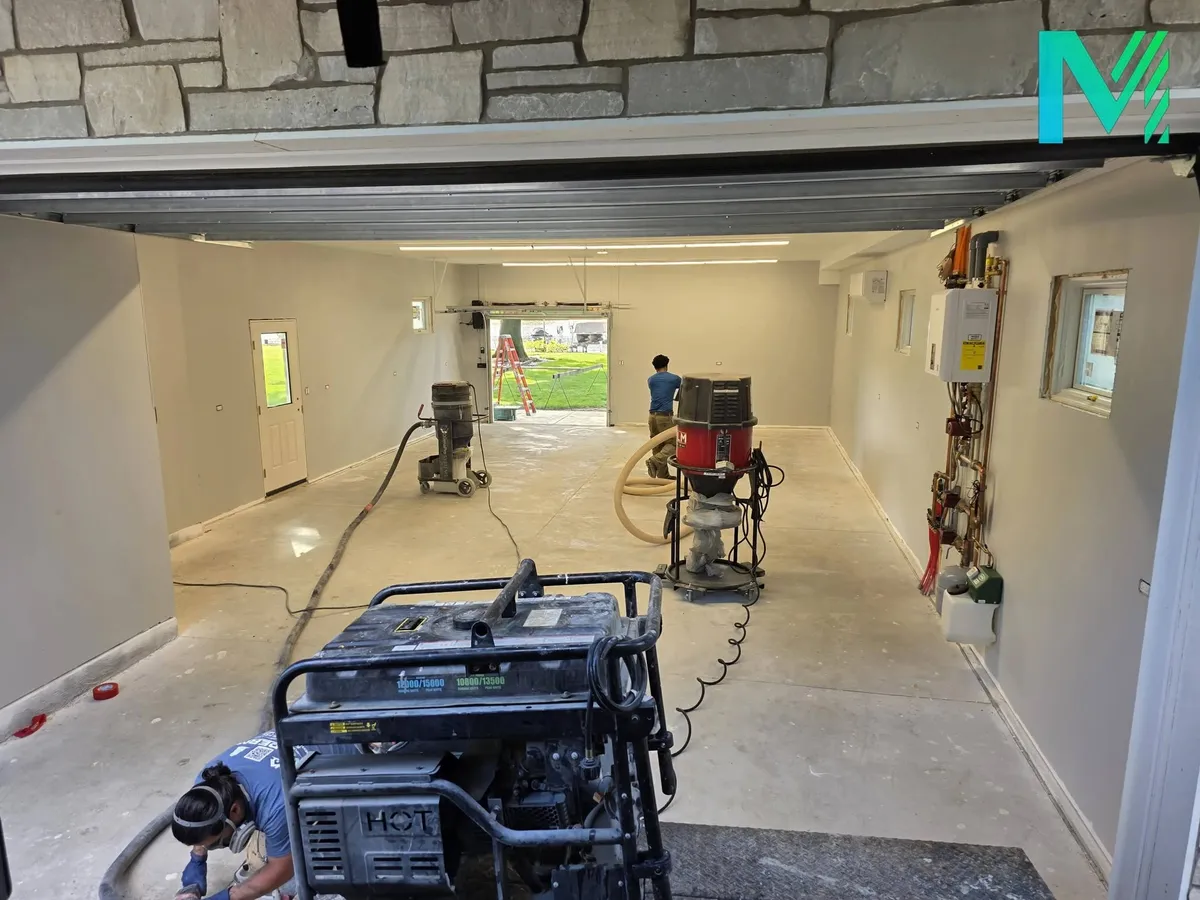
Kits tell you to clean the floor and etch it with a mild acid solution, then roll the coating on. Etching cleans the surface. It does not profile it. A coating bonds to concrete mechanically, by gripping an opened, roughened surface. Professional installers create that profile with industrial diamond grinders that remove the top layer of the slab and open the pores of the concrete.
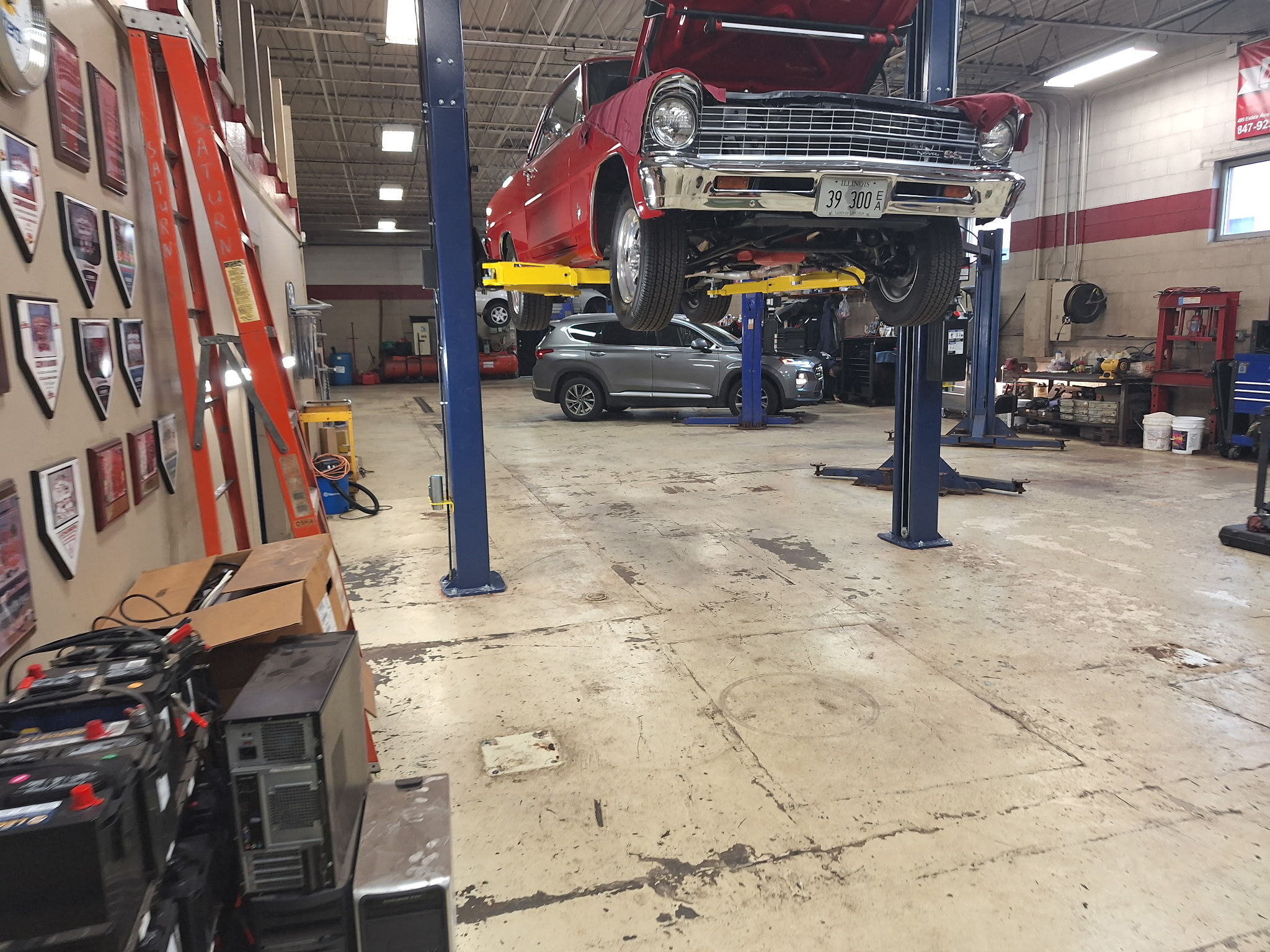
On a smooth, power troweled garage slab, an etched only floor gives the coating almost nothing to hold. The coating is then a sticker on glass. It holds until heat, moisture, or a tire pulls harder than the bond does, and then it lets go, usually starting at expansion joints, the door threshold, and the tire paths. Poor preparation is the number one reason epoxy floors fail, and it is built into the kit method.
Reason 2: The coating in the box is thin
Most retail kits are water based, low solids coatings that go down in a very thin film. Thin film means thin protection. A professional system builds real thickness: a primer and moisture barrier, a full body intermediate coat with flake broadcast into it, and a dedicated protective topcoat. That build is what resists impact, abrasion, and chemicals for 10 to 20 years. A single thin roll on coat is being asked to do the same job with a fraction of the material, and it wears, chips, and softens accordingly.
Reason 3: Hot tire pickup
Drive home on a summer day and your tires are hot, and the rubber is loaded with plasticizers that keep it flexible. Park on a thin, undercured coating and the heat and plasticizers soften it. As the tire cools and contracts, it grips the coating. Back out the next morning and the tire takes a tread shaped patch of floor with it.
Hot tire pickup is the signature failure of kit floors. It is preventable with a properly cured, full thickness system finished with a polyaspartic topcoat, which has far higher heat and abrasion resistance than a thin epoxy paint. If your floor is lifting only where the tires sit, this is almost certainly what happened.
Reason 4: Moisture from below, ignored completely
Concrete is a sponge. Ground moisture travels up through a slab as vapor, and Illinois clay soil and spring water tables make sure there is plenty of it. A coating sealed over a damp slab traps that vapor, pressure builds, and the floor blisters and peels from underneath, including in spots the car never touches. If your floor is bubbling in the middle or under stored items, moisture is the likely cause.
Kits do not test for moisture and do not include a moisture barrier. Our professional system starts with a moisture vapor barrier for exactly this reason, after the slab is diamond ground and any cracks and salt damage are repaired.
Winter makes all four reasons worse here. Road salt and slush sit on the floor for months, water works into every weak edge and crack, and freeze and thaw cycles pry at the bond line again and again. A marginal bond that survives a mild climate often does not survive one McHenry County winter.
How to tell which failure you have
- Peeling only in the tire paths: hot tire pickup. The coating itself softened and let go.
- Blisters or peeling across the whole floor, even under shelves: moisture vapor from below, or prep failure across the slab.
- Lifting at joints, edges, and the door line first: bond failure from poor profile, with water and salt working the edges.
- Yellowing where sunlight lands: a standard epoxy with no UV stable topcoat, aging in sun.

Can a failed DIY floor be fixed?
Spot repairs almost never hold, because the same weak bond exists across the whole floor, not just where it has visibly lifted. Painting over a peeling kit usually buys a few months and adds another layer that has to be removed later. The real fix is mechanical: grind the failed coating off down to bare concrete, profile the slab properly, repair cracks and damage, test and address moisture, then install a full system. That is more work than a first time professional install, which is exactly why the cheapest first attempt so often becomes the most expensive route to a good floor.
When a DIY kit is honestly fine
In the spirit of straight answers: if the space is a low stakes storage room or a workshop floor you do not park on, you understand it is a short term cosmetic coating, and you are fine redoing it in a few years, a kit is a reasonable weekend project. Just do not expect it to perform like a garage floor system, and do not put it on a slab with any moisture history. For a garage you park in every day, in this climate, the math favors doing it once, properly.
Frequently asked questions
Why is my epoxy garage floor peeling after one year?
Almost always one of four causes: prep that never profiled the concrete (acid etching instead of diamond grinding), a thin low solids coating, hot tire pickup, or moisture vapor pushing up through the slab. The pattern of the peeling usually tells you which one.
Can I coat over a peeling DIY epoxy floor?
Not reliably. New coating bonds to the old coating, and the old coating is already letting go of the concrete. The failed layer needs to be ground off first.
Does diamond grinding really matter that much?
Yes. It is the single biggest difference between a floor that lasts and a floor that peels. It opens the concrete so the system mechanically locks in, instead of sitting on a smooth surface.
What does a professional floor cost compared to a kit?
Our installed systems run $4 to $6 per square foot, with most 2 car garages at $1,600 to $3,000, installed in 1 to 2 days and built to last 10 to 20 years or more. See our cost guide for the full breakdown.
Get a floor that only gets done once
If your kit floor is failing, or you are deciding before you buy one, call or text (815) 949-4711. Most floors can be quoted over the phone in about five minutes, and estimates are free. See our system, finishes, and before and after work on the epoxy garage floor page. Modern Builders & Design is licensed, insured, and bonded, based in Fox River Grove, with more than 500 garages coated and a 5.0 star rating across 125 Google reviews, serving Barrington, Crystal Lake, Cary, Algonquin, Lake Zurich, Wauconda, McHenry, and the northwest suburbs.
