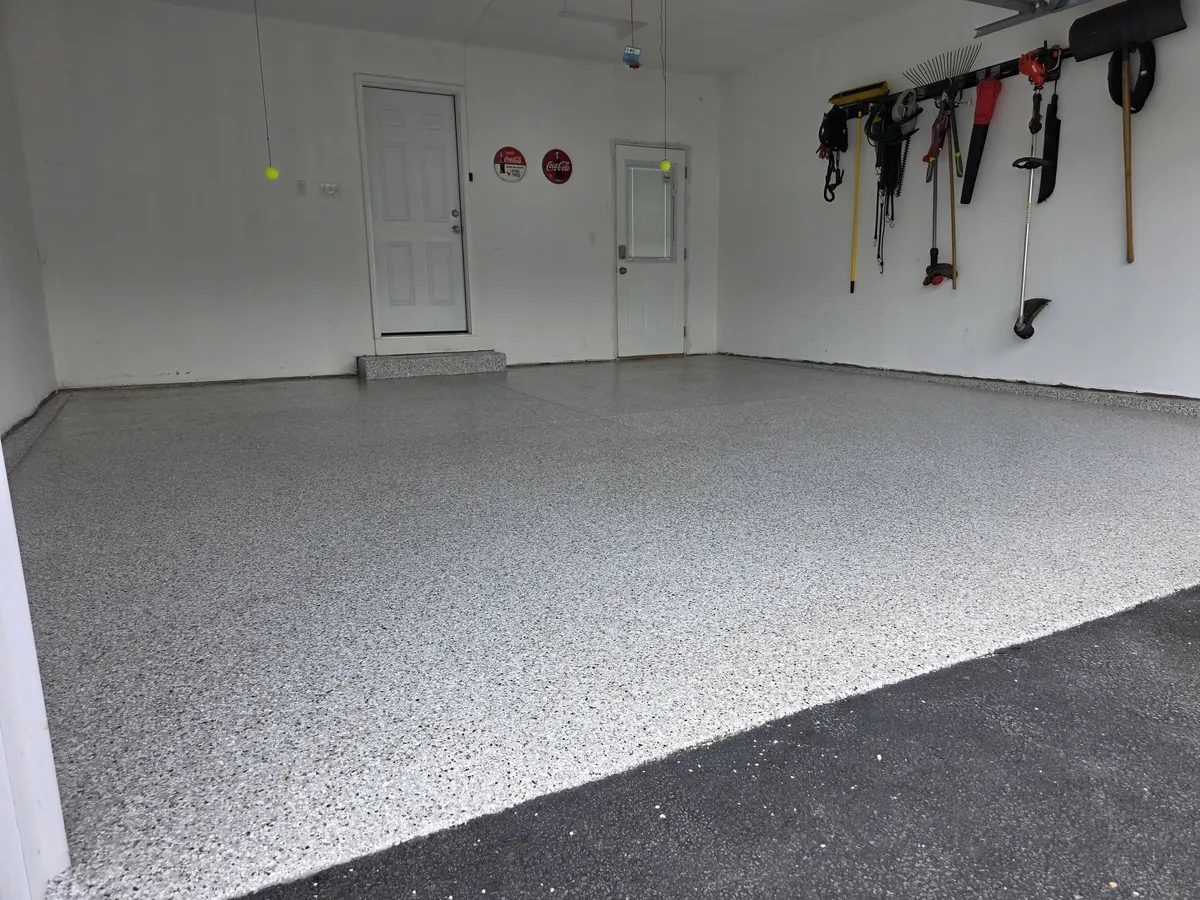
Epoxy vs Polyaspartic vs Polyurea: Which Garage Floor Coating Is Best for Illinois?
Shop for a garage floor coating in the Chicago suburbs for more than ten minutes and you will get three different answers from three different companies, each telling you the other two products are junk. Epoxy, polyurea, polyaspartic. Here is what each one actually is, what it does well, where it falls short in an Illinois garage, and why our answer is not one of them. It is a system that uses them together.
The short answer
For most northwest suburban garages, the best floor is a hybrid system: a moisture vapor barrier on the diamond ground slab, a polyurea intermediate coat with a full decorative flake broadcast, and a polyaspartic UV stable topcoat. That is exactly the system Modern Builders & Design installs. You get epoxy class build and bond underneath, with flexibility, fast cure, and sun resistance on top. If you only remember one thing, remember this: prep and system design matter more than the brand name on any single can.
Epoxy: the proven base
Epoxy is a two part resin that cures into a hard, dense coating with excellent bond to properly ground concrete. It builds thickness well, which is why it has been the workhorse of garage and commercial floors for decades, and it is the most affordable of the three per square foot.
Its limits are real. Standard epoxy can yellow or amber where sunlight reaches it through an open garage door. It is rigid, so it moves less willingly with a slab through freeze and thaw cycles. And it cures slowly, especially on a cold Illinois slab in winter, which stretches install timelines.
Best for: base coats, basements and interior floors with limited direct sun, and budget conscious builds where a quality topcoat seals it.
Polyurea: the flexible middle
Polyurea is a fast curing, flexible coating. That flexibility is its superpower in Illinois: a slab here expands in July heat and contracts in January cold, and a coating that can move with the concrete resists cracking and chipping better than a brittle one. It also bonds aggressively and handles moisture conditions better than standard epoxy.
Its trade off is speed. Polyurea sets fast, which leaves a short working window. It has to be installed by a crew that knows the material, because there is no time to fix mistakes mid floor. In the wrong hands, fast is a liability. In the right hands, it is an advantage.
Best for: the structural coat in a garage system, commercial floors, and slabs that see temperature swings and heavy use.
Polyaspartic: the topcoat of choice
Polyaspartic is a newer chemistry in the polyurea family, most often used as the final clear coat, and for good reasons. It is UV stable, so it will not yellow or fade in sunlight the way traditional epoxy does. It cures in hours, not days, so most floors are ready to use the very next day. And it has higher abrasion and impact resistance, which is what stands between your floor and hot tires, dropped tools, floor jacks, road salt, oil, and gas.
It goes on thinner than epoxy and costs more per square foot, which is why using it as the only coat is rarely the smart build. Used as the topcoat over a proper base, it protects everything underneath it.
Best for: topcoats on garages, sunlit spaces, fast turnarounds, and any floor where color stability matters.

Side by side
| Factor | Epoxy | Polyurea | Polyaspartic |
|---|---|---|---|
| Cure time | Slow, 24 to 48 hours or more | Very fast | Fast, hours |
| Sunlight and yellowing | Can yellow in direct sun | Good resistance | UV stable, will not yellow |
| Flexibility with slab movement | Rigid, more brittle | Flexible | Flexible |
| Build and thickness | Excellent build | Moderate | Thinner, best as topcoat |
| Hot tire resistance | Fair on its own | Good | Excellent as topcoat |
| Typical role in our system | Base and build | Intermediate coat with flake | Protective topcoat |
What an Illinois garage actually demands
A garage floor in Barrington, Crystal Lake, or Cary gets punished from both ends of the year. All winter, tires carry in road salt and slush that melt, soak, and refreeze. On bare or badly coated concrete, that cycle scales and pits the surface, starting at the door line and the tire paths. All summer, hot tires park in the same two spots every night, and sunlight pours through the open door. A coating here has to be flexible in January, hard in July, sealed against salt water, and stable in sun, at the same time. No single product wins all four. A layered system does.
There is one more demand nobody markets: moisture from below. Ground moisture pushes up through concrete as vapor, and a coating that traps it without a barrier will blister and lift from underneath. Our system starts with a moisture vapor barrier for exactly that reason.

Why we install a hybrid, in plain language
- We diamond grind the slab. Prep is the bond, and the bond is the floor.
- We apply a moisture vapor suppression primer and barrier, so vapor from below cannot push the system off.
- We lay a polyurea intermediate coat and broadcast decorative flake across the full floor for texture, durability, and slip resistance.
- We seal it with a polyaspartic UV stable topcoat that resists fading, scratching, chemicals, and hot tires.
That background is not an accident. Our Floor Coatings division was built on more than two decades of experience as a union trained industrial coatings applicator. Industrial floors do not get to fail politely, and we build residential garages to the same standard.
Frequently asked questions
Is polyaspartic better than epoxy for a garage floor?
As a topcoat, yes: it is UV stable, cures faster, and resists abrasion and hot tires better. As the whole system on its own, not necessarily. The strongest residential floors use each material where it performs best, in layers.
Will an epoxy floor yellow in my garage?
Standard epoxy can amber where strong sunlight reaches it. That is why our system finishes with a UV stable polyaspartic topcoat, which holds its color.
Which coating handles Illinois winter road salt best?
A sealed, well bonded system does, regardless of the label. Salt water needs to sit on top of the coating where it can be cleaned off, not soak into the slab or creep under a peeling edge. Flexibility through freeze and thaw and a moisture barrier underneath are what make that possible.
How long does installation take with a hybrid system?
Most garages are installed in 1 to 2 days, and most floors are ready to use the next day.
What does it cost?
Our installed garage floor systems run $4 to $6 per square foot. See our full epoxy garage floor cost guide for pricing by garage size.
Not sure which system your floor needs?
Most floors can be quoted right over the phone in about five minutes. Call or text (815) 949-4711, or see the system, finishes, and before and after photos on our epoxy garage floor page. Modern Builders & Design is licensed, insured, and bonded, based in Fox River Grove, with more than 500 garages coated across Barrington, Crystal Lake, Deer Park, Algonquin, Lake Zurich, and the northwest suburbs.
